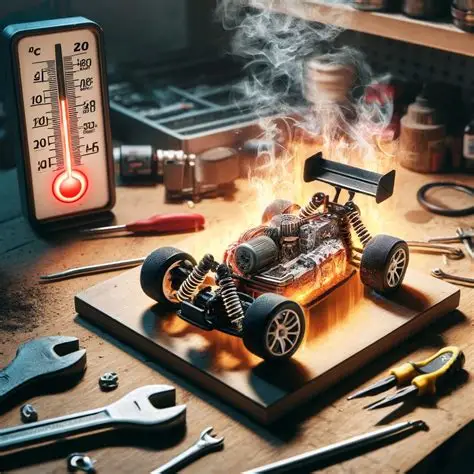
If your RC car motor gets hot after 5 minutes or even burning to the touch after just a few minutes of running, something is wrong. A little warmth after a run is normal. Scorching heat after 5 minutes is not. This guide will walk you through every possible cause and exactly how to fix it. What Is “Too Hot” for an RC Motor? A motor that’s warm (40–50°C / 104–122°F) after a run is usually fine. A motor you can’t hold your finger on for more than a second (above 70°C / 160°F) is too hot and will burn out faster or already be on its way out. A useful rule of thumb: if you can hold your fingertip on the motor can for 5 seconds without pulling away, the temperature is acceptable. If you pull away instantly, the motor is too hot.
Cause #1: The Motor Is Geared Too Low (Too High a Pinion)
This is the most common cause of motor overheating, especially after a recent upgrade or gear change. When the pinion (the small gear on the motor) is too big for the spur gear (the large gear on the drivetrain), the motor has to work much harder than it’s designed to.
Think of it like riding a bicycle in too high a gear your legs (the motor) exhaust much faster.
Fix: Use the “finger test” for gearing. After running for 3–4 minutes, stop and immediately touch the motor can. If it’s very hot, go down 1–2 teeth on the pinion gear (smaller pinion = less stress on the motor). Repeat until temperatures are comfortable.
Cause #2: A Binding Drivetrain
If something in the drivetrain the diffs, driveshafts, or gearbox is binding or not spinning freely, the motor has to fight extra resistance every time it turns. This extra load generates extra heat.
Fix: With the car powered off, spin each wheel by hand. They should all spin smoothly and freely. If any wheel feels stiff, rough, or catches, disassemble that section and check for:
- Worn or dry bearings (replace with new ball bearings)
- Bent driveshafts
- Debris or dirt in the gearbox
Cause #3: Running Too High a Voltage Battery
If your motor is rated for 2S LiPo (7.4V) and you’re running a 3S (11.1V), the extra voltage pushes more current through the motor than it’s designed for. The result: it runs hot, fast.
Fix: Check your motor’s voltage rating. It’s usually printed on the motor can or listed in the product manual. Only run batteries within the motor’s rated voltage range.
Cause #4: Wrong Motor KV for Your Vehicle
KV (revolutions per minute per volt) determines how fast a motor spins. A motor with too high a KV for your vehicle’s setup will spin extremely fast, pull excessive current, and run hot.
For example, a 4000 KV motor on a heavy basher truck is going to work much harder than a 2200 KV motor that’s better matched to the weight.
Fix: Use a motor KV appropriate for your vehicle type:
- 1/10 scale basher: 3000–4000 KV on 2S
- 1/10 scale racer: 4000–5500 KV on 2S or 3S (with proper gearing)
- 1/8 scale: 1500–2200 KV on 3S–4S
Cause #5: The Motor Is Dirty or Full of Debris
Dirt, grass, and fine particles can get inside the motor and restrict the rotor from spinning freely. This adds mechanical resistance, which becomes heat.
Fix: Use a can of compressed air to blow out the motor after each run. For a deeper clean, use a motor spray cleaner (RC motor cleaner is available from most hobby shops). Let it dry completely before running again.
Cause #6: Old or Worn Brushes (Brushed Motors Only)
If you’re running a brushed motor, the carbon brushes wear down over time. Worn brushes create more friction and more heat. They can also cause sparking inside the motor, which you might see as faint flashes in the dark.
Fix: Replace the brushes. Many brushed motors have replaceable brush sets available for a few dollars. If replacements aren’t available, it may be time for a new motor.
Cause #7: The Motor Needs to Be Broken In (New Motors)
Brand new brushed motors should be broken in before full-power running. Without break-in, the brushes and commutator don’t have even contact, which causes uneven friction and extra heat.
Fix: To break in a brushed motor, run it at very low throttle for 5–10 minutes, or do the “battery break-in” method by connecting it to a nearly-flat battery so it runs slowly.
Cause #8: Poor Ventilation on the Chassis
Some chassis designs trap heat underneath the motor, especially fully enclosed bodied cars running in hot weather.
Fix: Remove the body shell during casual bashing runs. This alone can drop motor temperatures significantly by improving airflow.
How to Measure Motor Temperature Accurately
A laser infrared thermometer (available for under $15) gives you an instant, accurate temperature reading. Point it at the motor can immediately after stopping. This removes the guesswork completely.
How to Add Cooling to Your Motor
- Stick-on motor heatsinks: Cheap, easy, and effective. They increase surface area so heat dissipates faster.
- Dedicated motor cooling fans: Most motors have a fan mount. Add a 30mm or 40mm 5V fan and connect it to your receiver’s auxiliary channel.
- Ventilation holes in the body: Some hobbyists drill small holes in the car’s body shell to allow hot air to escape.
Final Thoughts
A hot RC car motor is a warning sign, not a quirk. The fix is almost always gearing, voltage, or cleanliness none of which require expensive new parts. Fix the root cause rather than just adding cooling on top of an underlying problem. A well-matched, clean, properly geared motor should run comfortably warm never burning hot.
Frequently Asked Questions (FAQ)
Is it normal for an RC car motor to get warm?
Yes, some warmth is normal. Warm (hand-holdable) is fine. Too hot to touch is a problem.
Will running a hot motor for longer break it?
Yes. Sustained high temperatures degrade the motor’s windings and magnets, shortening its life significantly.
Can I use water to cool my motor mid-run?
Never. Water and electronics don’t mix. Let the motor cool naturally.
How do I know if my motor is already damaged from overheating?
Signs of a heat-damaged motor include reduced power, grinding noises, inconsistent performance, or a burning smell.
Does a brushless motor run cooler than a brushed motor?
Generally yes. Brushless motors are more efficient and generate less heat for the same power output.
My motor only gets hot when bashing, not when racing. Why?
Bashing involves frequent full-throttle bursts, jumps (which can cause motor overspin), and rough terrain. All of these demand more from the motor than smooth-surface racing.
How often should I check motor temperature?
Every session, at least once. Get in the habit of touching the motor after every run.